The short version
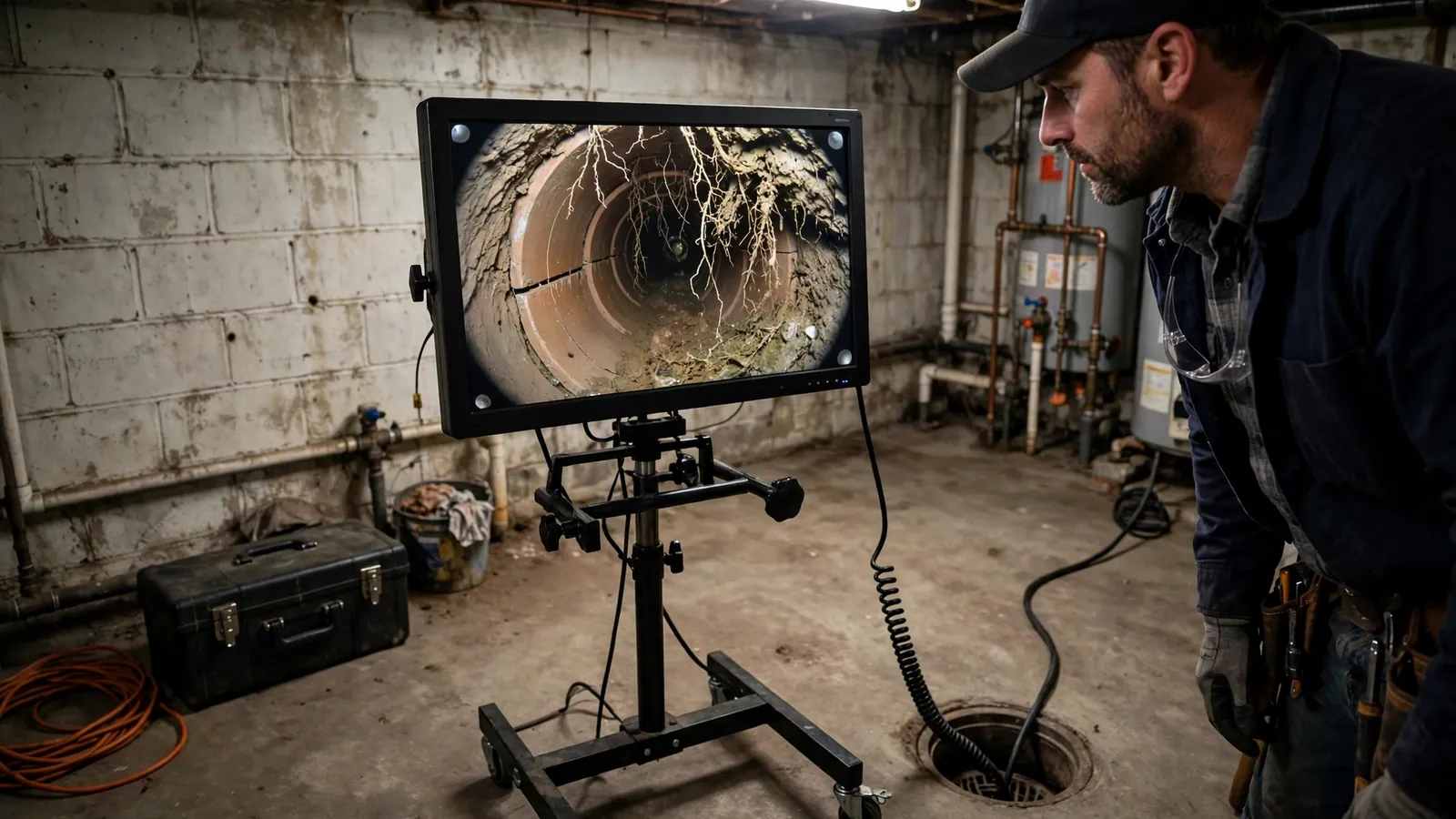
Problem: The camera shows the pipe material, every joint, every crack, every root, and the connection at the street main.
What to do: The locator marks each defect on the surface, with the depth — the map for any digging.
When to call: Call Now to have the line inspected and the findings explained in plain language.
What the camera sees
A sewer camera is a waterproof camera on a push cable, fed into the line through a cleanout or a pulled toilet. The inside of the pipe appears on a monitor in real time, and the operator sees the pipe material, every joint, every crack, every root, every low spot — and the distance and depth of each one, marked by the camera's locator beacon.
The camera shows the material first: clay tile, with short sections and a joint every two or three feet; cast iron, with a rough, dark interior and scale; or plastic, smooth and light-coloured with tight joints. The material tells the crew how old the line behaves, and what its failure pattern is likely to be. A clay line fails at the joints. A cast iron line narrows from the inside. A plastic line fails at a bad joint or a crushed section.
The camera also shows the damage: roots, and how much of the pipe they fill; cracks, breaks, and collapses; bellies, where the water level rises on the monitor; and the connection at the street main, and whether the line is clear all the way through. Each defect is noted with its distance from the access point and its depth, so the crew knows where to dig and how deep.
What the locator adds
The camera alone shows what is wrong. The locator shows where it is. A beacon in the camera head sends a signal that a surface locator reads, marking the line's path and the depth of each defect on the ground above. That matters when the fix involves digging: the crew digs at the defect, not along the whole line.
A camera report that says the collapse is twelve feet from the house at four feet deep is a very different job from one that says it is at the street. The locator marking is the map for the dig — and it is what keeps a spot repair a spot repair, instead of a trench along the whole run. The locate also marks the line itself, so the crew knows where it runs before any digging begins, and stays clear of other utilities.
The locator is also how the crew finds a line with no record. Many Parma homes have no plan showing where the lateral runs, and the camera and locator together map it: the path from the house to the street, the depth along the run, and the position of every defect. That map is useful for any later work on the line, and for a homeowner who wants to dig or build in the yard.
What the camera cannot see
A camera cannot see through the pipe wall, or see the soil around the pipe. It cannot tell whether the ground outside the pipe is washed out, or whether a section is about to collapse. It also cannot inspect a line that is full of water or blocked solid — the camera needs a path, so a badly blocked line is usually cleared first, then inspected. And it cannot inspect a line with no access point, unless one is created.
A camera also cannot see the future. It shows the condition of the line at the time of the inspection — the joints that have opened, the roots that have entered, the sections that have bellied. It cannot say when the next joint will fail, or when a section that is cracked will collapse. What it can do is show the condition clearly enough that the fix is chosen from evidence, and the homeowner knows what they are dealing with.
That is why the camera findings are kept as a record. The footage and the written findings show the line's condition at a point in time, and a later inspection can be compared against them. A line that has been inspected is a known quantity; a line that has not been inspected is a guess.
When to get a camera inspection
The most common reason is a symptom: several drains slow at once, the basement floor drain backs up, a sewer smell will not go away, or the line has been cleaned more than once and the problem keeps coming back. The camera shows the cause, so the fix matches the problem instead of the guess.
The second reason is a purchase. A camera inspection before buying a Parma home is one of the most useful inspections a buyer can order. Many homes still have their original clay tile laterals, and a lateral at the end of its life may show no symptom at all until it backs up. The inspection shows the condition of the line before the purchase is final.
The third reason is a plan. A homeowner who wants to dig, build, or plant in the yard should know where the lateral runs. The camera and locator map the line, so the digging stays clear of it. And a homeowner who has had a replacement or a repair should keep the camera footage — it is the record of the finished line, and it is useful for any later work.
What a good camera report tells you
A useful camera report answers five questions. What is the pipe made of, and how old does it behave? Where is the damage, and how deep? How bad is it — a crack, a belly, a collapse, or roots at one joint? Is the line clear to the street main? And what are the options — cleaning, spot repair, lining, bursting, or replacement?
If a report does not answer those questions, it is not complete. A report that says the line is 'in poor condition' without saying where, or how deep, or what the defects are, does not give you enough to choose a fix. Ask for the locations, the depths, and the footage.
The footage matters because sewer work is underground work. Once the line is buried again, nobody can see it. The camera recording is the only way to check what was found, and to compare the line's condition later if the problem returns. Ask for the recording and the written findings when the inspection is done.
What a camera cannot show
A camera inspection shows a great deal, but it does not show everything. It shows the inside of the pipe: the material, the joints, the defects, and the water level. It does not show the soil around the pipe, so it cannot show whether the ground outside has washed away and left a void. It does not show the water table, so it cannot show whether groundwater is pressing on the line from outside.
The camera also cannot show the future. A line that looks sound today can still fail, and a line with a minor defect can stay stable for years. What the camera shows is the condition at the time of the inspection, and the findings have to be read with the age of the line and the history of the house in mind. A clay line with one open joint in a 1950s home is a different situation from the same finding in a line that was replaced ten years ago.
That is why the camera is a starting point, not a verdict. The findings guide the next step — cleaning, spot repair, lining, bursting, or replacement — but the decision also weighs the age of the line, the pattern of past problems, and the plans for the house. A homeowner who is selling next year may choose differently from one who plans to stay for twenty. The camera gives the facts; the decision follows from the facts and the situation together.
Related: Cracked Sewer Pipe · Sewer Camera Inspection · sewer line replacement in Parma
Related guides
 Guides
Signs You Need Sewer Line Replacement in Parma, OH
Most Parma laterals are past the age clay tile was made to last. These are the signs that yours is failing — and what a camera inspection shows.
 Guides
What Is a Sewer Lateral? A Parma Homeowner Guide
The sewer lateral is the pipe that connects your home to the street main — and in Parma, it is the homeowner's responsibility. Here is what it is and what it does.
 Guides
Tree Roots in Sewer Line: What to Do in Parma, OH
Parma's mature maples and oaks are the main reason its clay laterals keep blocking. Here is what to do when roots are in your line — and how to fix it for good.
Frequently asked questions
Questions people ask about this topic, answered plainly.
Most residential inspections take well under an hour of work on site, once the camera is in the line. A long line, a line that needs clearing first, or a line with no easy access point takes longer. The crew explains the timing when the appointment is made.
No. The camera is a smooth head on a flexible cable, pushed gently through the line. It is made for this work, and it is the standard tool for inspecting sewer lines. If the camera cannot pass a section, that itself is a finding — it means the line is blocked or collapsed there.
A cleanout makes the job easier, but it is not always required. The camera can also enter through a pulled toilet. If there is no access at all, a cleanout can be installed — which also makes any future work on the line easier.
A camera can show water entering the pipe through a crack or a separated joint, and it can show a belly where water stands. It cannot see water leaking out of the pipe into the soil. A wet patch in the yard above the line, together with camera findings, points to where the line is failing.
The crew explains what the camera found, where the collapse is, and how deep — and what the options are. A collapse cannot be cleaned or lined; the collapsed section has to be dug and replaced, or the whole line replaced by bursting. The locator marking shows exactly where to dig.
The footage and the findings are the record of the inspection. Ask for the recording and the written findings when the inspection is done — they are useful for any later work on the line, and for a buyer or an insurer who asks about the line's condition.
Still have questions?
Call Now to reach a local sewer professional — describe the problem and what the line has been doing.
Call now for sewer line help
Tap Call Now to reach a local sewer professional. Tell them where the problem is, what the line has been doing, and whether wastewater is coming into the home.
Hours: Mon–Fri 7:00 AM–10:00 PM ET · Sat 8:00 AM–10:00 PM ET · Sun 7:00 AM–9:00 PM ET
Before you call
- Stop using water if the line is backing up.
- Keep people and pets away from any wastewater.
- Note which drains are slow, and which one backs up first.
- Note whether the problem happens in heavy rain, or all the time.
- Have the age of the home ready, if you know it.